Tuesday, October 29, 2013

IDPS disappointed but undaunted

The members of Invermere Deer Protection Society (IDPS) are disappointed the BC Supreme Court dismissed its petition challenging the District of Invermere on urban deer culling, it announced this morning (Oct. 29) in a press release.

The Supreme Court dismissal comes after two “difficult years of work and fundraising to facilitate hearing our public interest trial,” the IDPS noted.
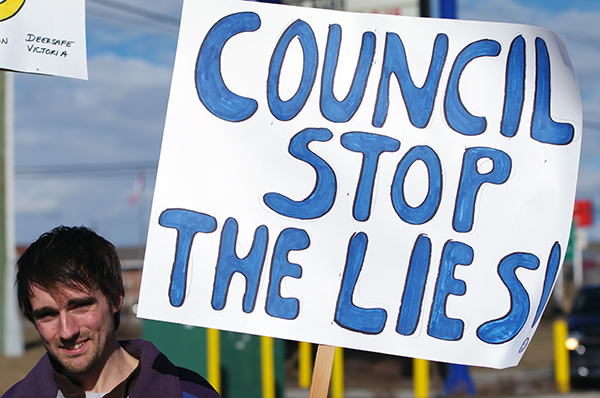
IDPS president Devin Kazakoff at an anti deer cull protest in Cranbrook last winter. Ian Cobb/e-KNOW
“We are a group of ordinary citizens opposed to lethal measures to deal with urban wildlife. Most of the money spent on the lawsuit was donated by local, caring citizens,” explained Devin Kazakoff, president of the society.

“A dismissal, with judgment neither for nor against IDPS, indicates merely that our arguments were considered insufficient. Unfortunately, the judge disallowed two critical response affidavits that severely diminished our arguments,” the press release outlined, adding, “A survey expert wrote that the District of Invermere householder survey was unreliable as a gauge of public opinion. And the second affidavit, of a highly qualified B.C. ungulate biologist, stressed the critical requirement that real science be used in municipal decisions about wildlife management. There is ample case law to stress the importance decisions are based on science.”

Charles Lamphier, IDPS director and long-time Invermere resident said, “The fact these affidavits were not used in court is unfair. But we advise municipalities to continue to acknowledge they are not expert in social or biological sciences and therefore they should step back from unsupported lethal decisions.”
The IDPS stated it is not overly surprised with the decision “but we worry about the future of deer and other wildlife living in our municipalities. The fact that some municipalities have reconsidered and decided not to apply to the province for killing permits is a victory in itself.”

“Grand Forks decided to hold off on culling and do scientific study instead, something every municipality facing deer complaints should be doing,” said Kathy Wilson, member of IDPS.

The IDPS says it will continue advocating and supporting non-lethal deer management through education, research and political action – “to defeat the killing mentality and negative attitudes to wildlife the District of Invermere so vigorously defends.”

Closing its release, the IDPS urges residents to vote ‘no’ in the Nov. 2 poll, tacked onto the referendum asking residents if they favour borrowing $5.6 million for a new community centre.

For more on the IDPS: https://www.facebook.com/InvermereDeerProtectionSociety

Saturday, October 26, 2013

Invermere deer cull upheld by B.C. Supreme Court

Judge rules the public was consulted before 19 were deer culled two years ago

CBC News Posted: Oct 25, 2013 1:20 PM PT
The B.C. Supreme Court ruled today that the District of Invermere followed due process before allowing 19 problem deers to be culled two years ago.
The B.C. Supreme Court ruled today that the District of Invermere followed due process before allowing 19 problem deers to be culled two years ago. (The Canadian Press)

A B.C. Supreme Court judge has ruled against some animal rights activists trying to stop the culling of deer in Invermere, B.C.
The district says aggressive deer are a threat to public safety, but the Invermere Deer Protection Society was arguing the town's council did not consult the community before going ahead with plans to destroy 19 deer two years ago.
Devin Kazakoff, head of the deer protection society, called the court's decision disappointing.
"They've agreed with the district on the fact that they consulted the public. We don't agree with the judge's decision, but that's what it is," he said.
Other B.C. communities had been watching this case closely because they use the same public process as Invermere to obtain permits from the provincial government to destroy deer.
Invermere Mayor Gerry Taft said the lawsuit was one of the "nastiest experiences I've ever had," and that he and his council received petitions, emails from all over the world and even death threats throughout the case.
"We're glad to have that over with," he said.
The issue of a deer cull in Invermere is not entirely settled, however. A public referendum on Nov. 2 will allow residents to decide if more permits for future culls should be sought by the district.
Kazakoff said he's confident the vote will vindicate his group's efforts.
"You get a few people that think they're aggressive of think they're a nuisance, but generally from the people I talk to... everybody loves the deer. I just hope that shows up in the vote," he told CBC News.

Wednesday, October 16, 2013

Compassion, Fear and Hard Lessons

Love them or hate them, deer in Greater Victoria is a topic that has brought out some very strong emotions in our citizens. A few letters of complaint to the CRD by some disgruntled gardeners has touched off a debate that has never been seen in the history of our region – should urban deer be culled now that some residents consider them a nuisance?

The nuts and bolts of such an undertaking have become onerous. What levels of government should take financial responsibility for a killing program, should culling be decided as the best “management” practice? How much input should taxpayers have in the process? Do the majority of taxpayers agree that killing is the way they want their tax dollars spent when so few residents are affected by deer? How many deer should die? Will culling in one municipality with an issue affect surrounding municipalities that have no issues with their deer?

Setting aside the political wrangling that this topic has created, there is an equally important occurrence happening here. Neighbours are pitted against one another, discussions at workplaces have become heated, and friendships have been damaged. All this before culling even occurs. Should killing begin in Greater Victoria these emotions will only escalate, creating a deeper rift among residents.

Individuals who are for killing have fallen victim to the very powerful emotion of fear. They have heard from media sources that deer carry Lyme disease, are capable of stomping our children and that they are going to kill motorists in accidents. Fear-mongering has been a surprisingly effective tool to turn people against a wild animal that they have very little to no contact with. Close on the heels of anxiety comes reprisal. An “us against them” mentality has sprung up in our city, with no need to research the actual threat, and the consequence to the deer may be the loss of their lives.

Those who believe that the deer do not deserve a death sentence are also becoming anxiety-ridden. The ease with which plans have been put into place to kill these animals has gone ahead with alarming speed, and the voices of the compassionate have been both mocked and ignored.

For more than a year now I have been out on the streets of our municipalities, asking residents to sign a petition against deer killing. I've seen first-hand what a contentious issue like this will bring out in people. I've spoken with people who love to see deer in their yards and parks, and I've had people put their faces within inches of mine and scream at me that the deer have eaten all the plants in their yards. It saddens me to see that the angry residents among us are very sure that they have a killing policy on their side, citing the deer committee recommendations as proof that culling is the only way to rid them of an irritant.

We have allowed far too much development on Southern Vancouver Island to ever return to anything that will approach a comeback to a natural environment. Pockets of Gary Oak meadows hemmed in by roads and development, where only preferred species are permitted to survive (depending on the aesthetic values of the “stewards” of the day) are yet another urban garden.

Perhaps the most alarming effect that culling deer will have will be a social one. In a society that claims to abhor bullying, children will be taught by their communities that violence is, in fact, an acceptable way to solve problems.

A safe and healthy environment should be the right of us all. The best way to achieve that is with compassion, and a non-lethal deer management approach. This is our opportunity to use the intelligence that we so often give ourselves credit for, rather than killing out of anger and fear.

Kelly Carson

Thursday, September 26, 2013

Pro-Cull Mayors Ask Premier for Help

Hospital, deer cull on the agenda

by Deborah Pfeiffer - Penticton - Story: 99087
Sep 24, 2013 / 7:09 am

In response to reports that Penticton sent a higher number of delegates than other  cities to the Union of BC Municipalities convention, Mayor Garry Litke said there was a reason most of the council attended.
Primarily that the city wanted to be well represented when pushing for the expansion of the Penticton Regional Hospital.
"We were there to ensure that by this time next year, the business plan will be completed, so that we can get treasury approval, so that construction can begin," he said. "I think Minister of Health Terry Lake was taken aback by the show of support and we had a very productive meeting."
All of the councillors, with the exception of John Vassilaki, attended last week's Vancouver convention, along with the mayor and city manager.
In addition to the discussions on the hospital,  individual councillors had their own agendas from the lack of skill trades training in Penticton to cultural tourism and making the city even more of a cycling destination.
Litke said he was also pleased the UBCM backed the council's resolution on photo radar in school zones.
The resolution stemmed from problems with speeding at Parkway Elementary School, calling for better solutions.
Litke also participated in a meeting on urban deer, with other mayors dealing with the problem from Invermere , Cranbrook, Kimberley and Vancouver Island.
In that meeting with Premier Christy Clark, Litke said issues ranging from safety to devastation of the urban landscape by animals that have no desire to live in the wild anymore were discussed.
Foremost on the minds of many was the deer cull case in Invermere that is presently before the courts.
The problem in Invermere began in December of 2011,  when the city hired a contractor to move ahead with a cull and a group calling itself the Invermere Deer Protection Society got upset and sued the city, claiming emotional damage from the trauma of imagining the deer being killed.
"Invermere is facing huge legal costs and people around the world are sending hate mail to the poor young mayor," he said. "So we are asking the premier to assist with the situation, because it has grown bigger than any municipality can handle."
Penticton will continue to watch what happens with the case, in the meantime working on gathering data on alternative means of deer control such as hazing or contraceptives.
"The research will be assembled, because we are looking for a solution," he said. "And we are happy the premier was so receptive and willing to work on this. She was very empathetic to our plea to do something about this because it is a wildlife issue not a municipal issue."

Sunday, September 22, 2013

A SECOND BUCK IS REPORTED IN OAK BAY WITH NETTING IN HIS ANTLERS

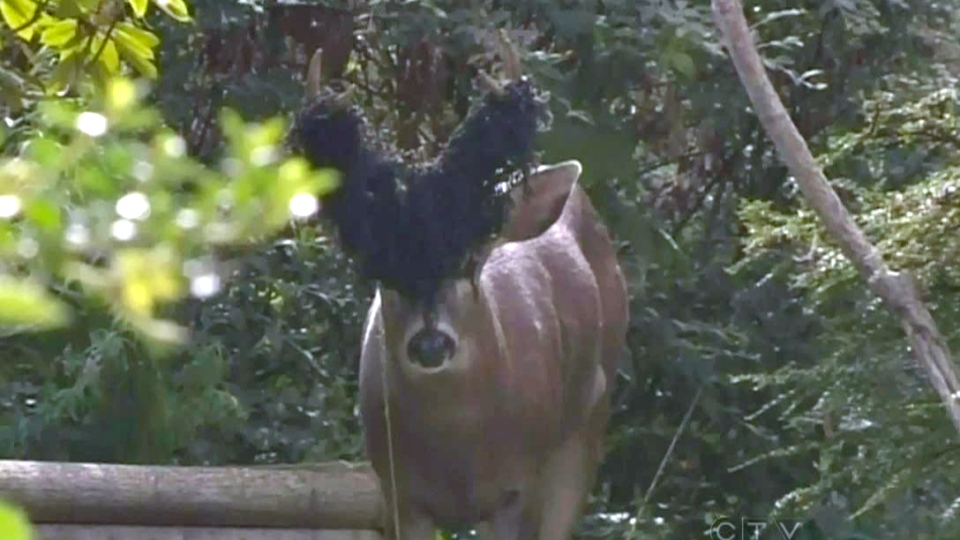
DeerSafe Victoria learned of a buck with netting on his head on August 19.  In that incident the netting had covered the buck's mouth and he was later reported on Linkleas Ave by several residents.  A Conservation Officer told DeerSafe that he had tranquilized the buck and removed the netting.  Yet another buck in Oak Bay has been seen with the same netting caught in his antlers.  The following is the CTV story:


A black tail deer has found itself with an unfortunate new headdress.

CTV British Columbia
Published Friday, September 20, 2013 9:38PM PDT
Last Updated Friday, September 20, 2013 9:43PM PDT
Conservation officers say there’s nothing they can do to help a deer that’s found itself with some humiliating new headwear.
Residents in the Victoria suburb of Oak Bay first noticed the blacktail buck a few weeks ago sporting what appears to be a curly new hairdo.

On closer inspection, they realized the Don King of deer had actually got its antlers tangled up in some plastic garden netting.

Photos

Don King of deer
A deer on Vancouver Island has found itself stuck in plastic garden netting, and there's nothing authorities can do to safely help. Sept. 20, 2013. (CTV)
“I was going to try and help him but decided I better not,” said Oak Bay resident Mia Barkasy. “So I took a picture of him and sent it to my husband saying, ‘And you think you’re having a bad Monday.’”
The netting isn’t affecting the deer’s health and doesn’t seem to bother him – but in a municipality that’s discussing a deer cull, it’s better not to stand out from the herd.
Unfortunately, there doesn’t seem to be a good way to help the deer get out.
Conservation officers say tranquilizing the animal to remove the netting could do more harm than good, so for now they’ve decided to leave it be.
Unless the situation changes, the buck may be in for a few months of embarrassment before shedding his antlers next year.
With a report from CTV British Columbia’s Ed Watson

Saturday, September 14, 2013

Friendly buck ‘John Deer’ has been euthanized in B.C. for being too familiar with humans

A B.C. deer famous for playing with preschoolers and nuzzling vacationers was killed by conservation officers this week because it was deemed to be too friendly.
“The deer was hand-raised and very habituated to humans, which made it a high risk for unpredictable behaviour,” read a statement by the B.C. Ministry of Environment, adding that “the deer’s behaviour was escalating due to the arrival of the breeding season.”

Provincial wildlife veterinarian Helen Schwantje says the docile deer was believed to be the same one that tangled its antlers in a child’s backpack as it tried to play with youngsters in a school playground during the first week of classes.
“I don’t think the deer needed to be euthanized … I just think it’s a tragedy,” said Liz White, a member of the Animal Alliance of Canada and a vocal opponent of a spate of recent B.C. deer culls.

On Thursday, environment officials argued that tranquilizing and relocating the deer would have been so traumatic, that it would probably have killed the animal anyway. “Translocation of deer is rarely humane,” read a statement.
As for sending the animal to a wildlife preserve, “integrating an animal with this behaviour into a captive herd would be an extreme challenge and may not be possible.”
Sadly, whenever “close encounters” with wild animals make the news, it usually signals impending doom for the animals themselves.

For five years, an orphaned killer whale named Luna became famous for loitering in the waters off Nootka Sound, B.C. In 2006, the animal was sucked into the propellers of a passing tugboat and killed.

In June, a Banff, Alta., motorcyclist gained international attention for photographing a wolf chasing him along a B.C. highway — a sure sign of an animal that had become dangerously accustomed to approaching humans for food handouts.

“They say a fed animal is a dead animal; it’s certainly something we try our best to discourage,” Omar McDadi, a Parks Canada spokesman told the National Post at the time.
 
| | Last Updated: 13/09/12 7:27 PM ET
National Post